HALL I
SCIENCE, FAITH AND ECONOMY
Three important features are on display in this area which serves as an introduction to Hispano-Islamic culture: science is represented by a sundial showing the hours of the day, with prominence given to the times of prayers; the signs of the zodiac; the arcs of the summer and winter solstices and the two lines of the shadow cast by the sun at the equinoxes.
In second place is faith, represented by the two Qur'ans representing the Holy Word written on pages illuminated with palmettes in the margins.
Finally, the economic environment is represented with a selection of coins from every Hispano-Islamic period from 712 AD to the Nasrid period.
HALL II.
EMIRATE AND CALPIHATE PERIOD
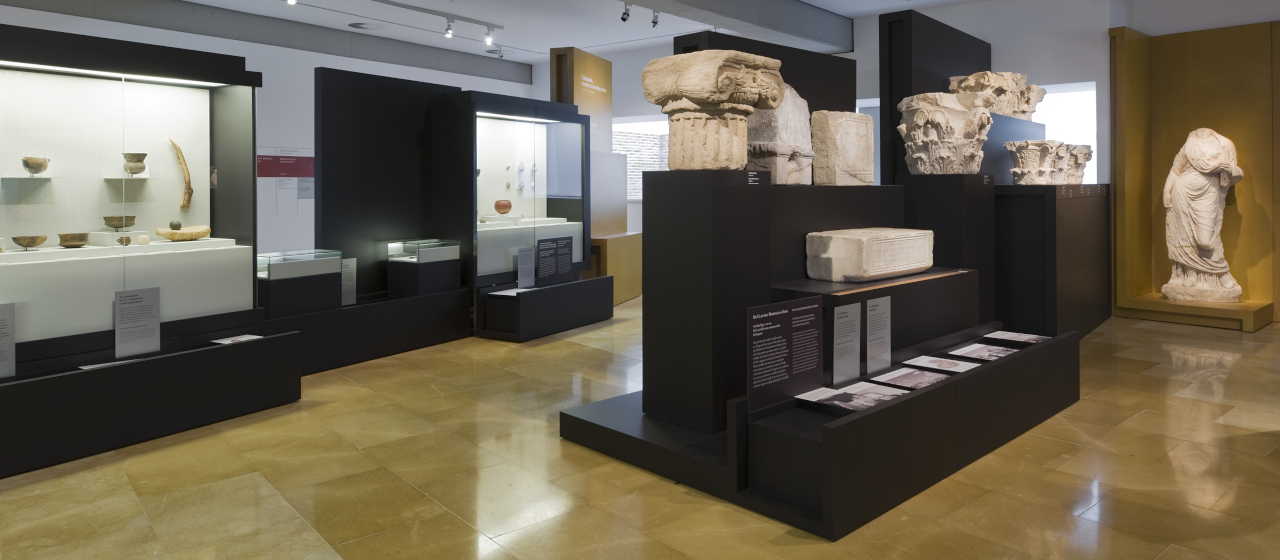
On display in this room are selected pieces that provide an insight into architectural and decorative advances, and the development of étiquette and lifestyles.
The examples of carved stone (decorative plaques, fountains, columns) are of great decorative quality and show the technical advances achieved, ranging from the influence of classical themes to the development of "home-grown" aesthetic solutions characterising the Caliphate style.
Household objects point to the value given to items in the home, with sublime examples of objects for lighting with figurative themes, such as oil lamps or small braziers worked in stone.
Serviceware demonstrate how objects were developed and adapted for use in the kitchen or at the table. Luxury items show a rich variety of ornamental themes in which the typical Caliphate colours were white, blue and manganese. The most popular pieces also have decorative features.
HALL III A
CALIPHATE ARCHITECTURAL DECORATION
The Almanzor-period fountain with deers and lions reveals the importance of water, a constant theme in Hispano-Islamic culture culture. This unique piece came to be appreciated as a work of art in later periods; it was moved to Granada and reused during the Zirid period in the Palace of the Badis and then relocated to the Alcazaba in the Alhambra during the reign of Muhammad III in 1305.
HALL III B
ART FROM THE TAIFAS TO THE NASRIDS
During the taifas, art production was influenced by the importance and power of individual taifa rulers but they all shared a common idea: imitation and continuity of the Caliphate period which was admired immensely.
The ivory workshop became much sought after by the Toledo taifas who set up their workshop in Cuenca. We can appreciate the plaque of carved ivory produced there.
Many of the pieces displayed in this room were intended to satisfy everyday needs at home and were part of the tableware (bottles, jugs and pitchers, bowls etc.) and were used for food storage, transportation and preservation (earthenware jars, breadbins...). These ceramics owe their decorative richness to their function inside the home. They show abundant technical skill and ornamental variety which significantly affected the subsequent development of these materials. Also at the museum are a set of bronze objects (mortars, incense burners and braziers) which give a good idea of the domestic environment in the Almoravid and Almohad periods.
HALL IV
NASRID PERIOD. PUBLIC BUILDINGS
The Nasrid city of Granada (1232-1492) had a large number of institutions, properties belonging to the sultan and other public edifices which reveal a city with significant intellectual and civic activity, including the madrasa (university), public markets, silk markets, mosques and the maristan (hospital).
The founding stone of this maristan which was set over the entrance gate has been preserved and is now on display. This horseshoe arch in white marble has an inscription dating construction between 1365 and 1367 during the reign of Muhammad V, who erected it and financed its upkeep as a free hospital.
The richness and beauty of the building is captured in this stone and the two fountains in the shape of large sitting lions from whose mouths water poured into the large pond at the centre of the maristan court.
From another building in the city, the Casa del Chapiz (the House of Chapiz) are the gorronares, the upper hinges, in white marble and decorated with polychrome stalactite work which supported the large leaves of the door to the gallery in the courtyard.
HALL V
NASRID PERIOD. THE ALHAMBRA AND OTHER CITY PALACES
One of the few signs remaining of the decorative furnishing of the Alhambra is the "Vase of the Gazelles". This exceptional Nasrid ceramic piece is decorated in white, blue and gold, and has a variety of epigraphic themes, highly delicate compositions of vegetal decoration and the figures which gave it its name, two pairs of gazelles.
Originally from the Palace of the Lions (Riyad) are two leaves of a door to the Hall of the Two Sisters (Qubba Mayor), examples of the fine Nasrid skill in woodwork, decorated with geometric strapwork panelling on both sides and carved pieces between the interlaced star patterns. From the same room is the screen from the upper floor. The palace decoration was complemented with other architectural elements, such as the remains of the floor from the Queen's Robing Room, with figurative themes and tiling.
The doors of the built-in cabinet from the Palace of the Princes provide us with an idea of the fine marquetry, or taracea inlay work used to decorate the doors of cupboards for storing belongings and other household items.
HALL VI.
NASRID PERIOD. THE RAUDA, SUMPTUOUS CERAMICS
As a palace city, the Alhambra also had an area set aside for the sultans' cemetery. It takes its name Rauda from its location in the gardens behind the Palace of the Lions (Riyad). The gravestones, used as headstones and burial slabs, from this area have been preserved. Two of these have the epitaphs of sultans Muhammad II and Yusuf III.
The Alhambra was part of the palace city and its Main Mosque was the site of significant events in the history of the Nasrids. Examples of the remains of this building can be found in the reproduction of the lamp of Muhammad III; two rows of arms holding crystal glasses lit the prayer room.
In the centre, the scissors chair (called a jamuga The various cabinets display a selection of the lavish tableware used at the palace and features a huge variety of shapes: sahfas, small serving bowls for personal use or large bowls for banquets, jugs, ewers, lids to protect food, pots to bring food to the table and a wealth of decoration in white, blue and gold, typical of quality Nasrid ceramics and with widely varied ornamental themes: human figures such as the drinker represented on one of the pieces on display; a variety of vegetal themes and designs; epigraphy as an ornamental accessory or a central decorative feature and geometric patterns as a background for the compositions or the key theme.
HALL VII A
NASRID PERIOD. DECORATION AND HOUSEHOLD ITEMS
This room presents the inside of a home or a palace as well as the fine and sumptuous household belongings from this period in history; the sculpted and polychrome finish of the palace walls; wooden roofs; textiles covering the walls or enclosing spaces in sumptuous red, yellow and glistening silk; and the domestic items and accessories for these rooms with boxes of marquetry, glass tableware, children's toys in a huge range of shapes, footwear, games such as chess and kitchenware.
HALL VII B
NASRID ART. THE ALHAMBRA, MATERIAL CULTURE
The display of examples of Nasrid material culture continues in this room; plaster panels used to cover walls, examples of woodwork, popular household tableware and toys.