RECOMMENDED TOUR ROUTE DURING A VISIT TO THE HISPANO-ROMAN CITY OF BAELO-CLAUDIA
Following the visit to the Visitor Centre and Museum, our proposed route begins. It starts as a pleasant stroll outside the city walls where we can have a fine view of the series of arches and then the canal or specum of the City's East aqueduct (1), which supplied some of the drinking water.
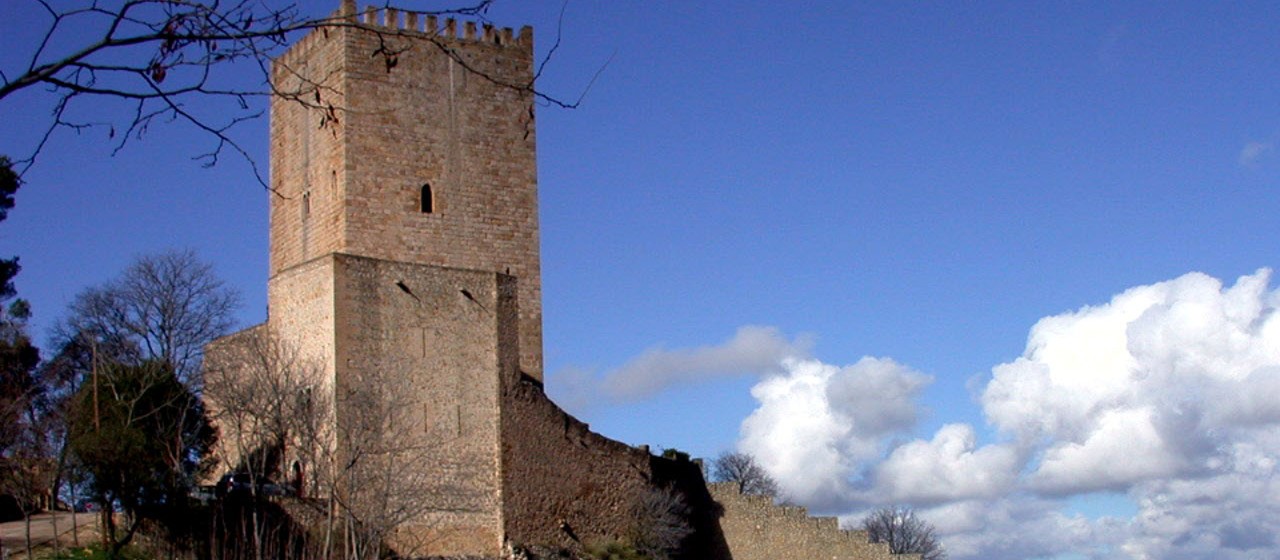
As we continue following the City Walls, we can see their architectural layout and how well preserved they are. The towers can also be clearly seen (2).
Before entering the City, we can see the large late Roman Necropolis (3), consisting of a significant number of burials close to the Walls and partially excavated in recent years.
We enter the City by one of its main gates, the East or Carteia Gate (4), and follow the route of the City's decumanus maximus. We continue up to the crossing with the cardus, which we follow south towards the Salting Factory, a vast industrial complex which is one of the largest excavated in the Iberian Peninsula and the only one located inside the walled enclosure (5).
Following the route signs, we return to the decumanus maximus, treading its original paving, to enter the South Square (6) where we can enjoy our first view of the monumental and civic centre of the City.
The monumental centre, where administrative, cultural and religious activities were carried out, is located at the crossing of two main streets, the decumanus maximus and the cardus maximus, organised around a paved square surrounded by two porticoes, called the forum (7). This is a typical forum from the end of the Republic and the beginning of the 1st century AD. Various public buildings take prime position around the forum. On the south side is the Basilica (8), a two-storey building used for the administering justice. The Basilica sealed the forum to the south, strengthening the impression of a closed square where public and religious life was carried out. On the north side, a platform or rostra was constructed for public speaking and, behind this is the monumental fountain which also served as a containment area for the open space in front of the temples. In the portico to the west, the following buildings were located, from south to north: the Municipal Archive or Tabularium (9), the voting hall (10), an administrative building and, according to some researchers, the Curia (11), a road and a building which could be a meeting hall for the local Senate or a Schola (12). In the east portico are the shops and tabernae (13). Before leaving the South Square we can see a small building adjoining the Basilica to the west. It has two side stairways: some researchers believe this is the Curia (14).
Retracing our steps to the decumanus maximus (15) we find the Macellum or market building (16) which was built with the aim of relocating the forum's commercial activities during the high imperial era. The building's well preserved ground plan clearly shows the layout of the space: a central courtyard with 10 shops to the side. The porticoed facade has four shops on the outside.
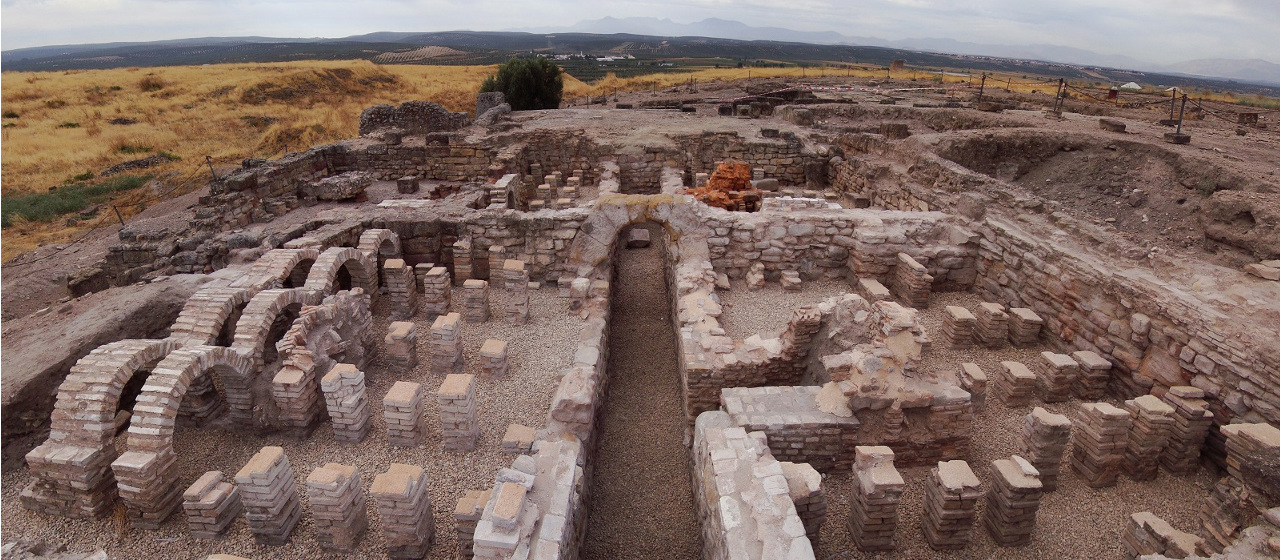
Continuing along the decumanus maximus we reach another of the main access gates to the City, the West or Gades Gate, which bears some similarity to the Carteia Gate (17). From here, outside the City, we access the hot baths (18) and head along cardus 1 to the Theatre (19), a building which took advantage of the gentle angle of the slope for the seats. It has seven entrances or vomitorios giving access to the various levels of the cavea.
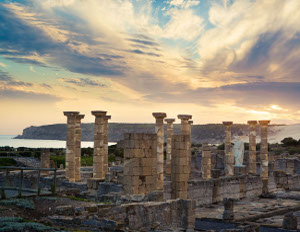
Finally, we visit the monumental or religious area, which clearly dominates the monumental and civic centre of the City on a higher terrace. This area comprises three symmetrical temples (20), traditionally identified as the Capitoline Triad, dedicated to the gods Juno, Jupiter and Minerva. As a result of the increasing importance of imperial worship among the Roman population, another temple dedicated to the Egyptian goddess Isis (21) was built beside these. It is the only one in Hispania that has been preserved entirely intact. From here, it is possible to make out the entire forum area with all the administrative buildings. Leaving the temple of Isis, we head east to a secondary city gate (22), parallel to the decumanus at the theatre, from where we pass outside the city walls and return to the Visitor Centre.